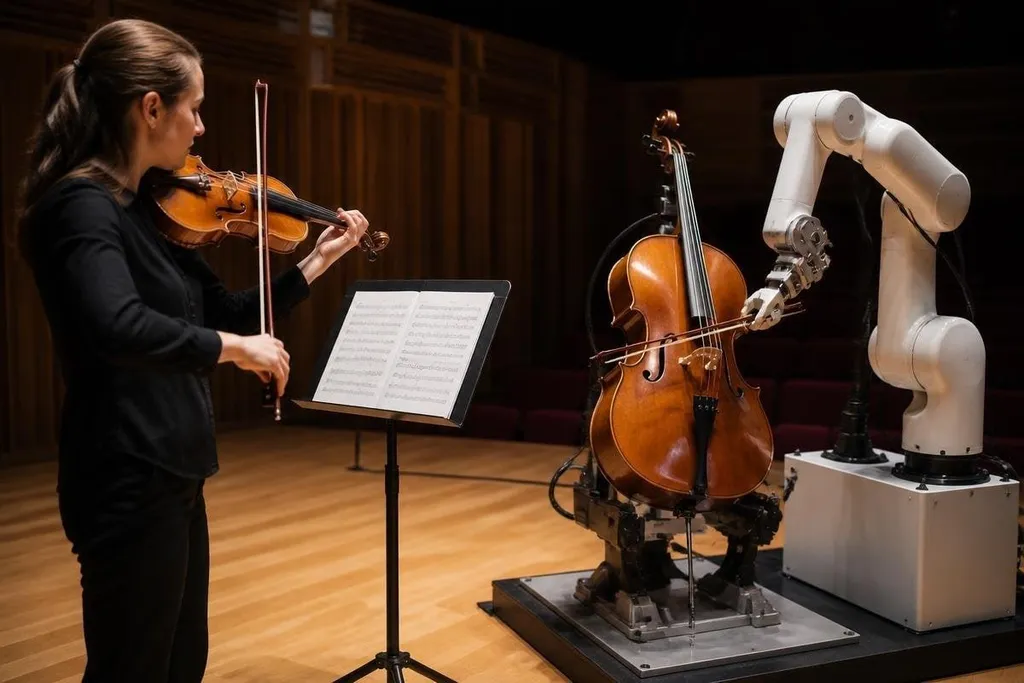
Music robots can strike strings, move percussion tools, or control sound through software. Their value depends on timing, repeatability, and how well a human performer can work with them. Without those three pieces, a robot adds motion without adding much to the music.
- Robotic instruments turn movement into sound through motors, actuators, or air systems.
- MIDI 1.0, MIDI 2.0, and Open Sound Control can connect software to performance hardware.
- The main limits are timing delay, setup time, safety, and the lack of human musical judgment.
What a music robot actually does
A music robot usually sits between a control signal and a physical action. A computer sends a note, speed, or force value. That command moves a mallet, presses a key, bows a string, or changes an instrument’s position.
That link matters because sound depends on more than the note itself. A drum hit can be early, late, soft, or hard. A string can ring for a long time after the actuator moves away. The control system has to manage those details while the piece continues.
Some systems use standard music control formats. MIDI 1.0 sends note and control messages, while MIDI 2.0 adds finer control over musical values.
Open Sound Control, often called OSC, sends messages across a network and can connect a performance system to software running on another computer.
The physical design sets the limits. A motor may move with high repeatability, yet the sound can still vary because of string tension, stick position, room acoustics, or changes in the instrument. That is why a robot playing the same part twice may produce two sounds that are close without being identical.
Where robots change performance
The clearest change comes from repeatable motion. A robotic arm can repeat a programmed movement during a long installation or keep playing after a human performer has left the stage. That makes it useful for works built around duration, repetition, or fixed physical patterns.
Robots can also make the instrument itself part of the performance. A moving drum, rotating bow, or shifting speaker changes what the audience sees as well as what they hear. The performer is no longer the only visible source of musical action.
That makes the control system part of the performance, too. Reporting from Robot24.com can connect a music robot’s sensors and control method to the motion heard and seen on stage. The next question is which parts should repeat, and which should stay under the musician’s control.
The strongest performances give the robot a defined job. A system might repeat a measured rhythm while a musician changes the melody, or it might respond to live input through sensors. The human supplies timing choices and expression; the robot handles a motion that needs steady repetition.
The limits on stage
A programmed robot follows its control rules. It does not hear a room in the same way a musician does, and it may not understand that an audience has gone quiet or that another performer has changed pace. A person can adjust in a moment. It needs a sensor, a rule, and enough time to react.
Delay becomes easy to hear when the robot works with live players. A small gap between a received note and a physical strike can change the groove. Network traffic, motor acceleration, and software scheduling can all add delay, so a test in an empty room may not match a full performance setup.
Safety also changes the stage plan. Moving arms and spinning parts need a clear work area, a reachable emergency stop, and a way to stop motion when a person enters the path. The system must be checked during setup, rehearsal, and any change to the instrument.
Cost is another limit. A full setup may need custom mounts, control software, sound equipment, sensors, and a technician. A low-cost actuator can look useful on paper while taking many hours to tune for one instrument.
A practical check before a live show
Use this list before you book a music robot for a performance:
- Define the motion: write down the exact action the robot must repeat and the force it needs.
- Measure delay: send live control signals and check the time from message to sound.
- Test the instrument: run the robot through the full range of notes, speeds, and striking points.
- Plan the stop: place the emergency stop where a nearby technician can reach it quickly.
- Budget the crew: include setup, tuning, repairs, transport, and rehearsal time.
- Give the human a role: decide which choices stay live during the performance.
I’d skip a music robot when the production needs quick human response but has no time for technical rehearsal. The better fit is a piece where the machine’s repeated physical action adds something the musician cannot maintain alone.
The next useful test is simple: run the robot beside a live performer for a full set, then measure how often timing, sound, or safety forces a stop.